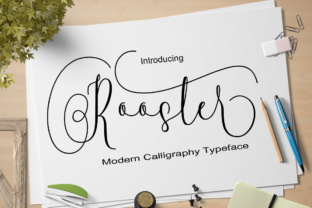
Why Rooster Script Feels Like the Artisan Font Your Brand is Missing
There is a specific kind of tension in modern design. We are surrounded by geometric sans-serifs and rigid grid systems that, while efficient, often strip the humanity out of a project. We see it on social media feeds where every post looks algorithmically generated, and on product packaging that feels cold to the touch. If you are a designer, entrepreneur, or creative professional trying to bridge that gap between digital precision and human warmth, you are likely hunting for a typeface that feels lived-in. You need something that carries the weight of tradition but fits comfortably into modern typography. This is exactly where Rooster Script enters the conversation.
At first glance, Rooster Script is a stylish calligraphy font, but describing it merely as "script" does it a disservice. It is a sophisticated assembly of hand-drawn glyphs that avoids the overly swirly, hard-to-read aesthetic that plagued cursive fonts ten years ago. The defining characteristic here is the weight of the lines. The glyphs feature thin, delicate strokes that mimic the pressure of a light hand on paper. It feels organic, but it is not messy. It is a premium font designed for projects that require a touch of elegance without sacrificing legibility.
The Anatomy of a Versatile Handwritten Font
When evaluating a script font, the devil is always in the details—or in this case, the alternates. One of the strongest arguments for investing in Rooster Script is the sheer volume of its library. We are looking at over 570 unique glyphs, with a staggering 384 alternate characters.
Why does that number matter to you? Because nothing kills the authenticity of a handwritten font faster than repetition. If you are designing a wedding invitation suite or a logo for a boutique coffee shop, seeing the exact same "t" or "o" repeated five times in a single sentence breaks the illusion of natural handwriting. With nearly 400 alternates, Rooster Script allows you to cycle through different styles of the same letter. This ensures that your brand identity looks genuinely crafted rather than digitally stamped. It gives you the creative freedom to make every word look unique, which is a massive asset in editorial design and high-end packaging design.
Matching the Font to the Project
Understanding the personality of Rooster Script is key to using it effectively. Because the strokes are thin and the style is airy, it functions best as a display font. It is not designed for body text; trying to read paragraphs of thin cursive on a screen is a recipe for eye strain. Instead, this is a typeface for headlines, pull quotes, logos, and accents.
Branding and Logo Design
For small business owners and entrepreneurs, your logo is often the first handshake you have with a customer. Rooster Script excels in industries that rely on trust and artisanship. Think of a florist, a boutique clothing line, a jewelry designer, or a high-end bakery. The thin, flowing nature of the font suggests care and attention to detail. It pairs beautifully with a sturdy serif font for the fine print or a clean sans serif font for a modern, minimalist contrast. This combination creates a visual hierarchy that guides the eye naturally from the brand name to the tagline.
Digital and Social Media Graphics
In the fast-paced world of social media, stopping the scroll is the primary objective. The "thin hand drawn" aesthetic of Rooster Script is currently very popular on platforms like Instagram and Pinterest because it feels personal. It looks less like a corporate advertisement and more like a note from a friend. Use it for quote graphics, story headers, or promotional announcements. However, readability on mobile devices is crucial. Because the lines are thin, ensure there is high contrast between the text color and the background. Avoid placing it over busy photographic backgrounds without a subtle drop shadow or a solid overlay to ensure the text pops.
Web Design and Digital Publishing
When used in web design, Rooster Script serves as an excellent counterpoint to blocky user interface elements. It works well for "Hero" section headers or specific call-to-action buttons where you want to draw attention. It adds a layer of sophistication that a standard system font cannot provide. For digital publishers and bloggers, using this font for chapter titles or section breaks can elevate the reading experience, making digital content feel more like a curated magazine.
The Strategic Impact on Brand Perception
Fonts are not just letters; they are psychological triggers. The choice of typeface influences how your audience perceives your professionalism and reliability. Using a creative font like Rooster Script signals that your brand values aesthetics. It suggests that you are part of the creative economy, whether you are selling digital products, physical goods, or services.
However, consistency is the anchor of brand identity. If you choose Rooster Script as your primary accent font, you must commit to it. Do not switch between three different script fonts across your website and your social media. The 384 alternate characters in Rooster Script give you enough variation to keep things fresh while maintaining a unified look. This consistency builds recognition. When a customer sees that specific thin, elegant stroke, they should immediately associate it with your brand.
Practical Tips for Implementation
Before you download and install, consider the practical side of integrating a commercial font into your workflow. Here is how to get the most out of Rooster Script:
- Master the Glyphs Panel: Do not just type and go. Open your Glyphs panel in Adobe Illustrator, Photoshop, or Affinity Designer. Scroll through the alternates. You might find that the standard "g" looks too stiff, but the alternate "g" has a beautiful trailing tail that fits your layout better. Manual adjustment is the difference between amateur and professional design.
- Check Your Licensing: Since you are likely using this for commercial purposes—whether it is a client logo, a t-shirt design, or a website—ensure you have the correct license. Rooster Script is a premium asset, and respecting the license protects you legally and supports the type designers who created it.
- Test for Scalability: Because the strokes are thin, this font may disappear if printed very small on textured paper or viewed on low-resolution screens. Always print a test page or view your design on a mobile device before finalizing. If the text becomes illegible at small sizes, pair it with a more robust sans serif font for those specific details.
- Kerning Matters: Script fonts often require manual kerning, especially when connecting letters. Even though Rooster Script is well-designed, specific letter combinations (like "ol" or "va") might need tightening or loosening to look natural. Pay attention to the negative space between letters to ensure the flow is uninterrupted.
Final Thoughts on Choosing Your Assets
In a market saturated with generic design assets, Rooster Script stands out because it offers depth. It is not just a single style; it is a toolkit of over 570 options that allows you to tailor the typography to your specific needs. Whether you are crafting a logo design for a new startup, laying out a wedding magazine, or creating social media graphics that need a personal touch, this font provides the flexibility and the aesthetic quality required to do the job right.
It strikes that rare balance between being a stylish calligraphy font and a functional design tool. It respects the traditions of modern typography while offering the digital convenience we need today. If you are looking to inject some humanity, warmth, and artisan quality into your next project, exploring the character set of Rooster Script is a worthwhile investment of your time.